
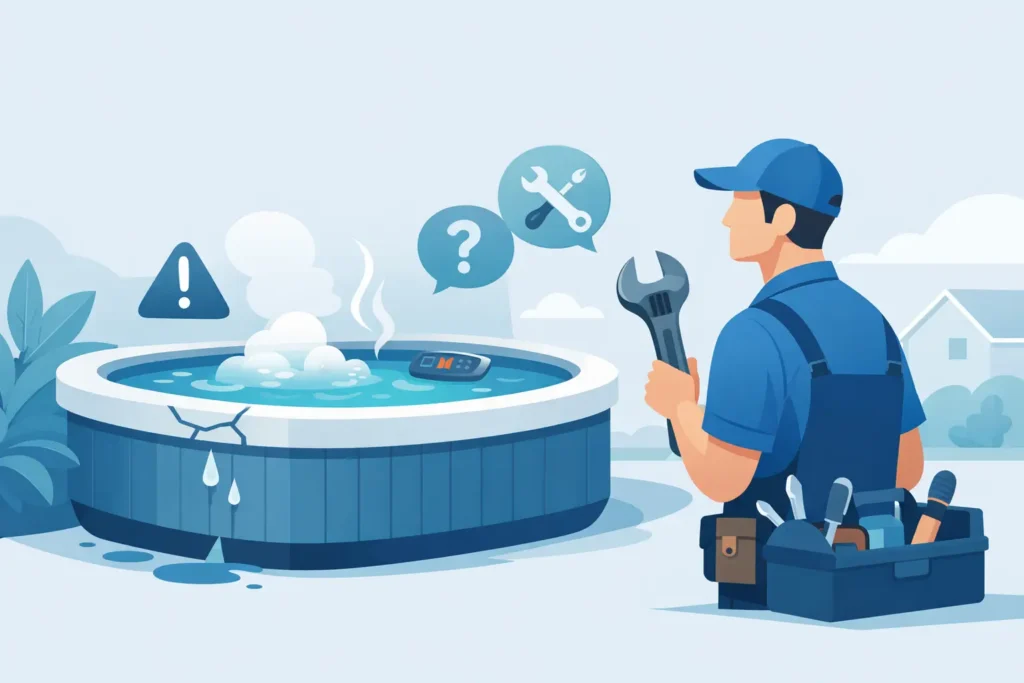
A spa should heat up, circulate clean water, and be ready when you want to use it. When it starts tripping the breaker, losing water, making unfamiliar noises, or refusing to heat, spa repair should not wait until a small issue becomes a larger equipment failure. For homeowners, HOAs, and commercial properties in the Santa Clarita Valley and San Fernando Valley, prompt professional service can protect both the spa equipment and the people who use it.
What Makes Spa Problems Urgent?
Not every spa issue means the system is about to fail. A slightly worn jet or a loose control knob may be a straightforward repair. But spas run hot, depend on reliable circulation, and combine water with electrical equipment. That makes some problems more time-sensitive than they appear.
A heater that is not working may be caused by a simple setting, a dirty filter restricting flow, or a failed component inside the heater assembly. A leak may come from a visible union fitting, but it can also originate below the shell, around a jet body, or in plumbing that is difficult to access. Guessing at the cause can lead to unnecessary part replacements, more water loss, or damage to surrounding surfaces.
For shared HOA and commercial spas, the stakes are even higher. A spa that cannot maintain proper circulation, temperature, or water quality can create an operational problem for residents, guests, and property managers. Closing the spa while the issue is assessed is often the responsible choice, especially when electrical concerns, cloudy water, or equipment leaks are involved.
Common Spa Repair Issues and What They May Mean
The Spa Will Not Heat
A cold spa is one of the most common service calls. Before assuming the heater has failed, a qualified technician checks the full system. Restricted water flow, a clogged filter, a circulation pump issue, a tripped breaker, incorrect programming, or a sensor problem can all prevent the heater from operating.
The right repair depends on the diagnosis. Replacing a heater when the actual issue is low flow does not solve the underlying problem. Conversely, continuing to reset a breaker or override a heater fault can risk further damage. If the spa repeatedly fails to reach temperature, shuts down during heating, or displays an error code, schedule service rather than repeatedly trying to restart it.
The Spa Is Leaking Water
A falling water level is not always a leak. Evaporation increases during hot, dry, or windy weather, and splash-out is common in an active household or community spa. Still, if the water level drops quickly or you notice wet soil, pooling water, stained decking, or moisture around equipment, it is time for an inspection.
Leaks can come from pump seals, heater connections, valves, plumbing unions, filter housings, cracked fittings, or the spa shell itself. The location matters. An accessible equipment-pad leak may be repaired quickly, while an underground or concealed plumbing leak requires more careful leak detection and repair planning. Acting early helps limit water waste and protects adjacent decking, landscaping, and equipment.
Jets Have Weak Flow or Do Not Work
Weak jets can make a spa feel disappointing, but they can also point to a circulation issue. Dirty filters, closed valves, air locks, clogged jet internals, low water level, and pump problems can all reduce jet performance. If one jet is weak while the others operate normally, the cause may be local to that jet. If the entire spa has poor flow, the pump, filter, or plumbing system deserves attention.
Do not ignore a pump that hums without moving water, surges, or becomes unusually loud. Running a pump under poor-flow conditions can strain the motor and may affect the heater as well. A technician can determine whether cleaning, adjustment, a seal repair, or pump service is the sensible next step.
The Breaker Trips or Controls Behave Erratically
Electrical issues call for caution. A breaker that trips once after a storm or power interruption may have a simple explanation, but a breaker that repeatedly trips should not be reset over and over. Water intrusion, a failing pump motor, a heater issue, damaged wiring, or a problem inside the control system may be involved.
Likewise, blinking control panels, unresponsive buttons, false temperature readings, and recurring error messages can stem from sensors, relays, circuit boards, or communication problems. These repairs require proper testing and should be handled by trained professionals. For safety, stop using the spa if you suspect an electrical issue and arrange an inspection promptly.
Why Diagnosis Comes Before Parts Replacement
Good spa repair starts with finding the actual cause, not simply replacing the part that seems most likely. A heater can fail because it has reached the end of its service life. It can also fail after months of restricted flow, scale buildup, or a circulation problem. Replacing the heater without correcting those conditions can shorten the life of the new equipment.
The same principle applies to leaks and pumps. A pump that loses prime might have a worn seal, a suction-side air leak, a blocked line, or a water-level issue. A professional evaluation helps separate the immediate symptom from the repair that will provide a dependable result.
For property managers and HOA boards, this approach also supports clearer decision-making. You should know what is wrong, what repair is recommended, whether there are alternatives, and what could happen if service is delayed. Honest communication is especially valuable when equipment is aging and repair-versus-replacement becomes a real question.
When Repair Makes Sense and When Replacement Is Smarter
Most spa equipment can be repaired, but repair is not always the best long-term value. The decision depends on the equipment age, the condition of related components, part availability, energy efficiency, and the cost of repeated service calls.
A newer pump with a leaking seal may be an excellent candidate for repair. An older pump with a failing motor, corrosion, and recurring electrical issues may be better replaced. A damaged control panel could be repaired if compatible parts are available, while an outdated system may justify an equipment upgrade that improves reliability and ease of use.
Heaters deserve the same practical evaluation. If a heater has a repairable sensor or pressure-switch issue, a targeted repair may restore service quickly. If the unit is heavily scaled, corroded, or repeatedly failing, replacement can prevent more downtime. The goal is not to sell the largest project. It is to recommend the work that makes sense for the spa, the property, and the expected use.
Preventive Care Reduces Emergency Spa Repair Calls
Regular service cannot prevent every failure, but it can catch problems before they become disruptive. Balanced water protects surfaces, heaters, seals, and internal equipment. Clean filters support proper circulation. Routine inspections can reveal small leaks, loose fittings, unusual pump noise, and early signs of corrosion.
For residential owners, simple habits help: keep the water at the proper level, follow recommended filter-cleaning intervals, keep the cover in good condition, and pay attention when the spa sounds or performs differently. Avoid adding products without understanding their purpose, since incorrect chemical use can create water-quality issues and damage equipment.
For HOAs, apartments, and commercial properties, consistent documented service is particularly valuable. Shared spas experience heavier use, and problems need to be addressed with resident safety, cleanliness, and operational continuity in mind. A service provider familiar with commercial and HOA pool environments can help identify concerns early and communicate repair needs clearly.
Choose a Contractor Who Takes Ownership of the Work
Spa systems are connected systems. Heating, circulation, filtration, plumbing, electrical controls, and water chemistry all affect one another. Choosing a licensed, insured contractor with hands-on repair experience gives you a clearer path from diagnosis to completed work.
Adrian’s Pro Pools provides spa and pool repair service for homeowners, HOAs, and commercial properties throughout the Santa Clarita Valley and San Fernando Valley. With experienced technicians, straightforward communication, and a commitment to quality work, the team can help identify the problem, explain the recommended repair, and get your spa back to dependable operation.
If your spa is leaking, failing to heat, tripping power, or showing signs of poor circulation, do not wait for the inconvenience to become equipment damage. A timely inspection gives you the best chance to make a focused repair, protect your property, and get back to enjoying a spa that works the way it should.