
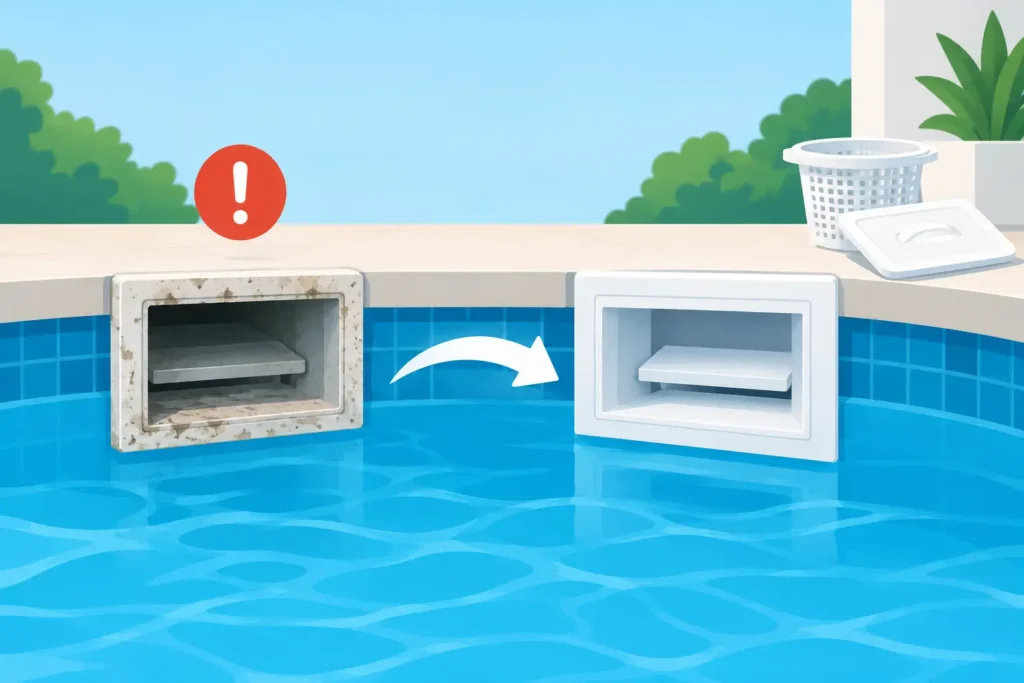
A pool can lose water for weeks before the real source becomes obvious. If the water level consistently drops to the bottom of the skimmer opening, or the surrounding deck shows cracking, movement, or damp spots, pool skimmer replacement may be the repair that stops a small leak from becoming a larger structural and plumbing problem.
The skimmer is the opening at the pool wall that draws in surface water, leaves, oils, and debris before water travels through the filtration system. It works quietly when everything is sound. But because it connects the pool shell, plumbing line, coping, and deck area, a failed skimmer can affect far more than circulation. For homeowners, HOAs, and property managers in the Santa Clarita Valley and San Fernando Valley, prompt diagnosis helps protect the pool, reduce water waste, and keep the facility ready for use.
When Does a Pool Skimmer Need Replacement?
Not every skimmer problem requires full replacement. A worn basket, floating weir door, lid, or vacuum plate is usually a straightforward parts repair. A damaged skimmer body or failing connection between the skimmer and pool shell is different. Those issues can allow water to escape behind the pool wall, under the deck, or into the soil surrounding the structure.
A consistent water-loss pattern is one of the clearest warning signs. Evaporation happens, especially during hot, dry California weather, but evaporation should not repeatedly stop at the same level. When the water drops to the bottom of the skimmer throat and then slows significantly, the leak may be in the skimmer body, its plumbing connection, or the joint where it meets the pool shell.
Other signs deserve a professional inspection. These include a visible crack in the skimmer, loose or separating tile near the opening, a deck section that has settled, air entering the pump basket, or difficulty maintaining a normal water level. A skimmer that visibly moves when the deck shifts is not a cosmetic concern. Movement can stress the plumbing line and expand a small crack with each change in temperature or soil condition.
For shared pools, signs may also appear in operating records. Repeated fill-water use, unexplained chemical demand, or a pump that loses prime can indicate a leak that needs attention. Addressing it early is usually less disruptive than waiting until a deck repair and plumbing repair must be completed at the same time.
Why Skimmer Leaks Should Not Be Ignored
Water escaping at the skimmer does not always create an obvious puddle. It may travel through soil beneath the deck, soften supporting material, or contribute to deck movement over time. In some cases, a leak can wash out soil near plumbing lines or create a pathway for water to reach areas it should not reach.
There is also an equipment concern. A skimmer leak can introduce air into the suction side of the circulation system. That can cause poor skimming, lower pump performance, noisy operation, and difficulty keeping the pump primed. If water falls below the skimmer opening, the pump may pull air rather than water, which should be avoided.
For an HOA, apartment community, or commercial property, the practical impact goes beyond the repair itself. A leak can lead to avoidable closures, resident complaints, higher utility costs, and scheduling challenges. A qualified contractor can help identify the scope of work, communicate what needs authorization, and complete the repair with attention to pool operation and property conditions.
How Pool Skimmer Replacement Is Diagnosed
A proper repair begins by confirming the source of the problem. Water loss can come from the skimmer, but it can also come from a return fitting, light niche, plumbing line, shell crack, or equipment pad. Replacing the skimmer without a clear diagnosis can waste time and leave the actual leak unresolved.
The inspection typically starts with the water level, the skimmer throat, visible cracks, and the condition of the surrounding deck and coping. A technician may use dye testing around suspected cracks or fittings and conduct pressure testing when a plumbing leak is possible. The goal is to separate ordinary evaporation from a structural or plumbing issue and identify whether the skimmer itself is the failure point.
The pool type matters. A concrete or gunite pool often requires careful removal of deck material and bond beam concrete around the skimmer. A vinyl-lined pool uses a different skimmer arrangement, and replacement may involve the liner faceplate and gasket system. Fiberglass pools have their own installation details and require care to prevent damage to the shell finish. The right process depends on how the pool was built, not just on the replacement part.
What the Replacement Process Usually Involves
Once replacement is approved, the repair area is prepared to protect the pool and surrounding property. The water may need to be lowered below the skimmer opening. For many concrete pools, the contractor then saw-cuts and removes a controlled section of deck or coping adjacent to the skimmer. This creates access to the failed body and its plumbing connection.
The damaged skimmer is removed, and the suction plumbing is inspected before the new unit is installed. This step matters because a cracked fitting or compromised pipe near the skimmer can cause continued leakage if it is not repaired at the same time. The new skimmer must be set at the correct height and alignment so the opening sits properly with the tile line and pool finish.
After plumbing connections are completed, the area around the skimmer is rebuilt with materials suited to the pool structure. The pool-side connection is sealed and finished to create a watertight transition. The deck section is then patched or restored as closely as practical to the surrounding surface.
A repair patch may not be invisible, particularly when existing concrete has weathered, faded, or has a decorative finish. Honest expectations are important. A skilled repair prioritizes structural integrity, proper function, and a clean appearance, but exact color and texture matching can depend on the age and condition of the existing deck.
Before the job is considered complete, the system should be checked for leaks, proper water flow, and stable pump operation. The skimmer weir, basket, lid, and suction performance should also be verified. Good workmanship includes leaving the work area clean and explaining any recommended follow-up, such as monitoring the water level after the pool is refilled.
Repair or Replace: Making the Right Call
Replacement is not always the first answer. If the skimmer body is intact and the problem is a deteriorated lid, basket, weir, gasket, or threaded fitting, a targeted repair may be enough. A minor surface crack may also be repairable depending on its location, depth, and whether it is actively leaking.
Replacement is generally the better long-term choice when the plastic body is split, the skimmer has shifted away from the pool shell, the connection has failed repeatedly, or access work is already required to repair plumbing immediately behind it. In those situations, attempting a temporary patch can create repeat service calls and further deck disruption later.
Cost depends on access, pool construction, deck material, plumbing condition, and finish work. A skimmer that can be reached with limited demolition will usually be less involved than one surrounded by thick concrete, stone coping, or decorative hardscape. For this reason, an on-site evaluation is the most reliable way to understand the work required and receive a clear scope before repairs begin.
Planning the Work for Homes and Shared Pools
Homeowners can often schedule the repair around normal pool use, although swimming should wait until the work area is safe, the water is at the proper level, and the circulation system is operating correctly. If a remodel is already planned, skimmer replacement can sometimes be coordinated with new coping, tile, plaster, or deck work to reduce duplicate demolition.
For HOAs and commercial properties, planning should account for resident communication, pool access, work hours, safety barriers, and the time needed for testing and restoration. The best approach is not simply the fastest patch. It is a repair plan that protects the property, keeps decision-makers informed, and supports a dependable return to service.
At Adrian’s Pro Pools, our licensed team approaches skimmer repairs with the same accountability we bring to weekly maintenance, equipment service, remodeling, and construction. If your water level keeps falling near the skimmer or the deck around it is changing, arranging an inspection now can help you make a clear decision before the damage spreads.